
Beatles remixes
They're fun and illegal to make

While I was making my last podcast episode on the Beatles’ “Blackbird”, I made a mashup of the various versions I discussed. I love remixing Beatles songs, it’s a habit I got into when I first started producing electronic music twenty years ago and it’s something I keep coming back to. Here’s a representative sampling:
Remixing these songs is easy for me, because I know them inside and out, backwards and forwards, both as compositions and, more importantly, as recordings. Music is an art form about memory. Recorded music can sink itself especially deeply into your memory because you can listen to specific recordings so many times. It only takes a fraction of a second to recognize a track you know well; a fragment that’s shorter than a single note or syllable can do it. Recontextualizing a familiar recording is a powerful artistic tool, because it can give you such strong and immediate listener connection.
Wenatchee The Hatchet is a blogger who frequently writes responses to things I post online. A while ago I posted a batch of remixes of “Dreams” by Fleetwood Mac, and he had this thoughtful take on them:
Now I do have a thought about what is actually very important in Hein’s remixes and what they have to do with music. The most significant power in creating musical connections and developing musical possibilities is memory.
So, the thing about memory and music is that juxtaposition and rhythm are significant. Hein’s experiments show that it is possible to reconceive melodic materials in shifting harmonic and rhythmic contexts. This is only possible if you have refined your powers of associative memory to the point where you can drop a Stevie Nicks vocal over the instrumental tracks of a song by the Bee Gees. Leveraging associative memory for musically expressive purposes is what Johann Sebastian Bach did when he created a fugal first movement for the Credo of his Mass in B minor by using the incipit of the ancient plainchant as the subject of his fugue. Once we consider that the fugal subject is the incipit of the Credo then this could be considered one of the more epic sample flips in “classical music”, to go back to a post Ethan Hein did called “fugue as sample flip“.
I am very happy to be compared to Bach! By flipping samples, I can connect and juxtapose pieces of recorded music together, and can create new topological connections within a single recording. Not everyone likes my remixes. my kids sometimes ask me, “So what song are you ruining now?” But the remixes have an immediate visceral power that my “original” music can’t touch.
I like singing songs and playing them on instruments, including Beatles songs, and have done some live renditions that I’m proud of. I did an arrangement of “Dear Prudence” for one of my jazz bands, and we sometimes stretched the tune out to epic lengths. The first song I ever sang harmony on in public was “If I Fell” at a coffeehouse show with some friends in college. But as much fun as performing Beatles songs can be, some of them are almost impossible to adapt or interpret because they’e so tied to specific sonic realizations on those albums. “Blackbird” is a case in point. The album version is so iconic that you either have to try to recreate it, which is pointless, or you try something different, and then it just makes people wish they were hearing the original. I have covered “Blackbird” onstage a few times, and I even whistled the bird chirps, but I don’t feel like I brought much to the song.
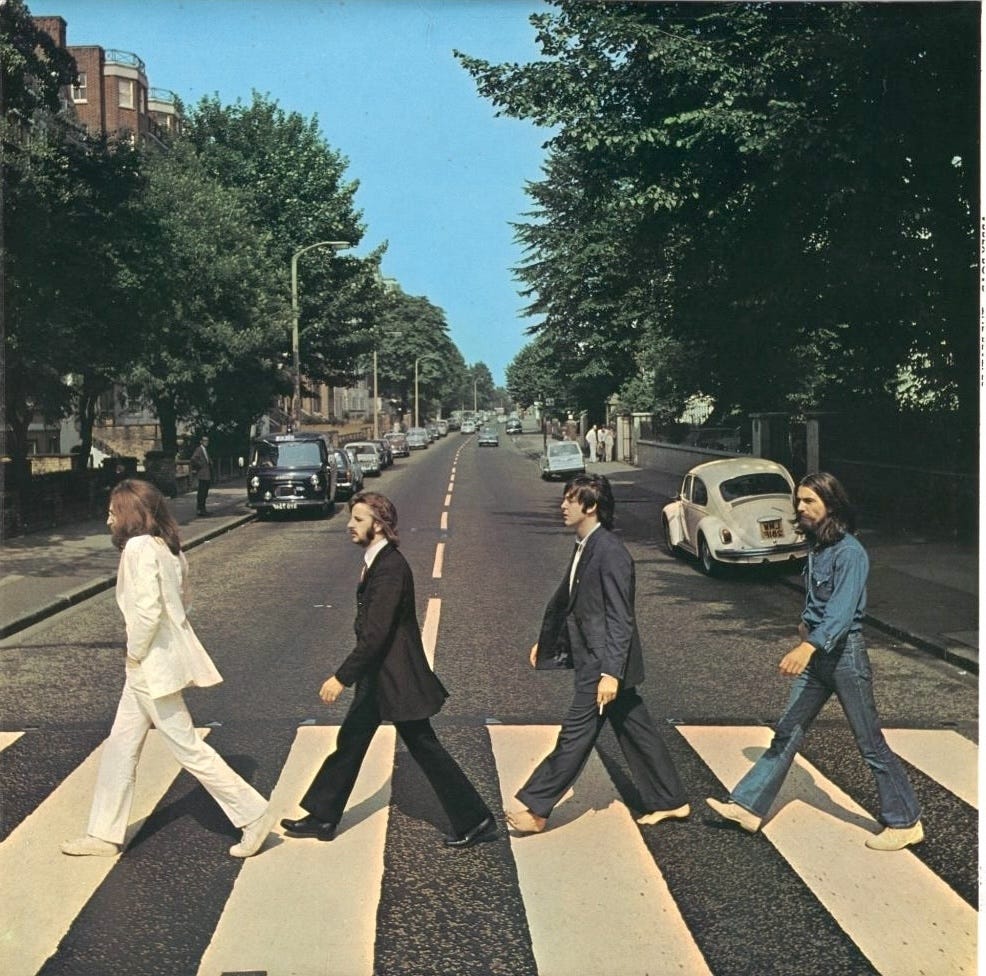
But how could I not want to engage creatively with those late Beatles albums? I grew up with them, and I know them better than any other cultural artifacts. There are millions of other people have a similarly close relationship to those albums. I need to be able to participate in the sound of those songs, not just the notes and rhythms. I can’t do that with the guitar, but I can with Ableton Live. Though not legally!
